How to choose an HVAC contractor for residential installation
Most often you underestimate the impact of contractor selection; you should verify licenses, insurance, and local references, compare written estimates and energy-efficient options, check manufacturer certifications and warranties, and confirm experience with your system type to ensure proper sizing and reliable operation.
Key Takeaways:
- Verify license, insurance, and local code compliance; confirm the contractor pulls permits and has experience with your home type.
- Obtain multiple written quotes based on a Manual J load calculation—compare equipment sizing, efficiency (SEER/HSPF), ductwork scope, and total installed cost.
- Check references and online reviews; confirm manufacturer and installer warranties and available service/maintenance agreements.
Understanding Your HVAC Needs
Assessing Your Home's Requirements
You should evaluate square footage, ceiling height, insulation R-values, window orientation, and local climate to size a system accurately. A Manual J load calculation often shows, for example, an 1,800 sq ft, moderate-insulation home in climate zone 4 needs roughly 2.5–3.5 tons; use that for contractor quotes. Also inspect duct condition, note occupancy patterns, and plan for future additions or major appliances that add heat load.
- Square footage and ceiling heights
- Insulation levels and window types
- Existing ductwork condition and layout
- Occupancy, schedules, and high-load rooms
- This provides contractors a precise scope for Manual J and proper equipment sizing
Types of HVAC Systems Available
Split systems (central AC plus furnace) remain common with SEER 13–21; heat pumps deliver heating and cooling with efficiencies up to 200% in mild climates; ductless mini-splits offer multi-zone control for additions or homes without ducts; packaged units suit tight rooftops; geothermal systems reduce operating costs 30–60% but raise upfront investment.
| Split System (central) | SEER 13–21; typical cost $3,500–$10,000; best for homes with ducts and variable climates |
| Heat Pump | SEER 15–20, HSPF 8–11; efficient in mild/cold with cold-climate models; $4,000–$12,000 |
| Ductless Mini-Split | SEER 18–30 per zone; ideal for additions/retrofits; $2,000–$7,000 per zone installed |
| Packaged Unit | All-in-one rooftop option; SEER 13–18; $3,000–$8,000; good for small homes or limited space |
| Geothermal | Coefficient of Performance (COP) 3–5; cuts energy use 30–60%; higher install $10,000–$30,000 |
If you live in a cold northern state, a cold-climate heat pump with HSPF 8–11 can replace a furnace; in humid southern regions, a high-SEER central system with variable-speed compressor improves dehumidification. You should ask contractors to present SEER/HSPF/EER ratings, projected annual energy costs, and warranty details so you can compare lifecycle performance rather than just upfront price.
- Match system type to your climate and existing ductwork
- Compare SEER, HSPF, and EER to estimate efficiency and savings
- Request sample installs, local references, and permit handling
- Weigh upfront cost against estimated annual energy and maintenance
- This ensures you pick a system that balances performance, comfort, and long-term cost
Researching HVAC Contractors
When narrowing your shortlist, focus on verifiable details: request three written estimates, confirm proposed equipment models (for example, a 3-ton Trane or Carrier unit), compare SEER ratings and warranty lengths, and ask for a start-to-finish timeline. You should also verify who pulls permits and whether the quote includes ductwork, permits, and post-installation testing so you avoid surprise costs or missed compliance steps.
Checking Credentials and Certifications
You must verify state contractor licensing and business registration, confirm liability and workers' compensation insurance, and check for technician certifications like NATE and EPA 608 for refrigerant handling. Factory-authorized dealer status for brands such as Trane or Carrier indicates manufacturer training. Look up license numbers on your state licensing board and note any disciplinary actions before moving forward.
How to Verify an HVAC License in Virginia (2-Minute Check)
Don't take "licensed and insured" on faith — verify it. Virginia contractors are licensed through the Department of Professional and Occupational Regulation (DPOR). Go to the DPOR License Lookup at dpor.virginia.gov, search the company name, and check three things: the license is active, it's the right class for your job (Class C covers projects up to $10,000 per job, Class B up to $120,000, Class A unlimited — most full system replacements need Class B or A), and it carries the HVA (HVAC) specialty designation. While you're at it, ask for a certificate of insurance naming both liability and workers' comp. A legitimate contractor will send it the same day without getting defensive. Anyone installing refrigerant-based equipment also needs EPA Section 608 certification — ask.
Reading Reviews and Testimonials
Scan Google, Yelp, Angi, and the BBB for installation-specific reviews from the past 12 months, watching for consistent mentions of punctuality, cleanup, and system performance. Pay attention to quantified results—reviews that cite a 15–20% drop in bills after a new heat pump, or that an install took 1–3 days—since those details reveal real-world outcomes you can expect.
Dig deeper by contacting at least two past customers listed in reviews; ask whether final costs matched estimates, if warranties were honored, and whether permits were pulled. Also review photos and contractor responses to complaints—timely, professional replies indicate accountability—and flag patterns like repeated ductwork issues or billing disputes before you commit.
What to Actually Look For in Reviews
Star ratings alone are easy to game. Read for patterns instead: Do reviewers mention the same tech by name repeatedly? (Consistency of crew.) Do reviews describe how problems were handled , not just "great service"? (Anyone can be great when nothing goes wrong.) Are there detailed reviews about quotes matching final invoices? (Pricing honesty.) Check that reviews live on the contractor's Google Business Profile — not just their website, where they control the feed. And be wary of a perfect 5.0 with 400+ reviews and none longer than a sentence; volume with no substance is its own red flag.
Evaluating Contractor Experience
Evaluate measurable experience: check years in business, certifications (NATE, EPA Section 608), manufacturer factory training, warranty handling, and a portfolio showing at least ten residential installs similar to yours. You should scan online reviews, request three recent references, and confirm they pull permits and complete final inspections to avoid surprises.
Years in Business
Aim for contractors with at least five years in business; a decade or more indicates they’ve navigated seasonal load changes, code updates, and supply-chain shifts. You should verify current licensing, insurance, and a local permit history—companies operating 12–15 years in your area often have established relationships with inspectors and parts suppliers that speed project timelines.
Areas of Expertise
Check their specialties: ductwork design, Manual J load calculations, heat pumps, minisplits, geothermal, high‑efficiency furnaces, zoning and smart controls. You should prefer teams with NATE and manufacturer certifications (Carrier, Trane, Mitsubishi) plus EPA 608 for refrigerant work; for example, if you need a 3‑ton heat pump for a 2,000 sq ft house, hire contractors who've installed comparable systems.
Ask for concrete examples: photos, permit numbers, and contactable references from recent jobs like yours. Verify they performed Manual J, Manual D and Manual S where applicable, and request measured startup performance—CFM, static pressure, and delta‑T—to confirm the installation meets design targets. Also check warranty handling and whether seasonal tune‑ups are included in the installation package.
Requesting Estimates
What to Include in the Estimate
Ask each contractor for a written, itemized estimate that lists equipment brand, model and SEER rating; system tonnage and AHRI reference; labor hours, line set length, ductwork work and permit fees; refrigerant type and charge; start/completion dates; and detailed warranty terms (parts, labor, compressor) with years listed—get at least three estimates so you can compare apples to apples.
Estimate Breakdown| Item | What to check |
|---|---|
| Equipment | Brand, model number, SEER, tonnage, AHRI cert |
| Scope | Removal, install, duct repairs, thermostat, refrigerant |
| Costs | Itemized parts, labor hours/rate, permit fees |
| Timeline | Projected start, duration, completion date |
| Warranties | Years for parts, labor, compressor; transferability |
| Extras | Rebates, financing, change-order policy |
Comparing Quotes
Compare total installed cost and cost-per-ton (e.g., $8,500 ÷ 3 = $2,833/ton), check differing scopes like duct sealing or new thermostat, and note SEER differences—16 SEER can cut cooling energy roughly 10–15% vs 14 SEER; also verify which quote includes permits, disposal and a written labor warranty so you avoid low bids that omit necessary work.
Quote Comparison Checklist| Factor | What to verify |
|---|---|
| Price | Total installed cost and payment schedule |
| Efficiency | SEER rating and expected energy savings |
| Scope | Ductwork, line set, pad, thermostat, permits |
| Warranty | Length and what is covered (parts/labor) |
| Inclusions | Rebates, disposal, start/completion dates |
Run a simple lifecycle check: calculate the incremental cost for higher SEER, estimate annual energy savings (use local rates; e.g., $110/yr saved), then divide incremental cost by savings to get payback—if Quote A is $8,500 for 3‑ton 16 SEER and Quote B is $7,200 for 3‑ton 14 SEER, the $1,300 premium with a $110/yr saving gives ~12‑year payback, which you can weigh against unit life (15–20 years).
Cost Analysis Example| Feature | Quote A vs Quote B |
|---|---|
| Price | Quote A: $8,500 (3‑ton, 16 SEER) / Quote B: $7,200 (3‑ton, 14 SEER) |
| Scope | A: includes duct sealing & new thermostat / B: basic change‑out, no duct work |
| Warranties | A: 10‑yr parts / B: 5‑yr parts |
| Estimated savings | A: ≈$110/yr vs B, payback ≈12 years on $1,300 premium |
Importance of Warranties and Guarantees
You should treat warranties and guarantees as part of the system's value, not an afterthought; manufacturer coverage often protects parts for 5–10 years and compressors for 10–12 years, while installer labor warranties commonly run 1–2 years. Inspect exclusions like improper maintenance, serial-number registration windows, and required service intervals, since those determine whether a claim will succeed. When comparing bids, quantify expected out-of-pocket exposure if a key component fails within the first five years.
Types of Warranties Offered
Many contractors combine manufacturer parts warranties, compressor-specific guarantees, and installer labor promises; parts coverage typically ranges 5–10 years, compressors often 10+ years on qualifying models, and labor is usually 1–2 years unless extended. You should note registration deadlines (commonly 60–90 days) and any prorated terms. Any extended warranty you consider must specify what is covered, who services claims, and any registration or maintenance conditions.
- Manufacturer parts warranty — usually 5–10 years (register to maximize).
- Compressor warranty — frequently 10–12 years on higher-end units.
- Labor/installer warranty — commonly 1–2 years; ask about extensions.
- Extended/protection plans — can add up to 20 years on parts for an extra fee.
- Performance/efficiency guarantees — some contractors guarantee output or SEER-based performance for 1–5 years.
| Warranty Type | Typical Coverage / Example |
|---|---|
| Manufacturer parts | 5–10 years; registration within 60–90 days often required for full term |
| Compressor | 10–12 years on many OEM models; critical for system life-cycle cost |
| Labor / Installer | 1–2 years standard; extendable via service contracts or promos |
| Extended / Protection Plan | Adds parts/labor for a fee; can include annual tune-ups and priority service |
| Performance Guarantee | 1–5 years; contractor refunds or fixes if specified BTU/SEER targets not met |
Understanding Maintenance Agreements
You should expect maintenance agreements to specify frequency (most common: two visits per year — spring and fall), scope (filters, coil cleaning, refrigerant check, electrical safety, thermostat calibration), and cost (typical range $150–$300 per visit or $200–$500 total annually with multi-visit plans). Contracts often include priority scheduling, waived diagnostic fees, and discounts on parts or emergency labor; verify whether the plan is required to keep your manufacturer warranty valid.
For example, homeowners who enroll in a $299/year plan that provides two seasonal tune-ups and priority response often avoid larger failures: catching a refrigerant leak early can prevent a $2,000 compressor replacement. You should also examine cancellation terms, automatic renewal periods, response times (24–48 hours for non-emergency, faster for emergency clauses), and whether the agreement is transferable if you sell the house, since those details affect long-term value.
Hiring Local in Staunton, Waynesboro & Augusta County
Valley-specific advice: our climate swings from humid 90-degree summers to single-digit winter nights, so ask any contractor how they size for both seasons — a system sized only for summer cooling will struggle in January. Ask whether they actually service your area year-round or only when schedules are light; rural Augusta County and Highland County homeowners get dropped by Harrisonburg- and Charlottesville-based outfits every winter. And ask where they're physically based — a contractor 15 minutes away in Staunton gets to your emergency faster than one 50 minutes out, every time.
Making Your Final Decision
Weigh written estimates, warranties and references side-by-side: get at least three bids, verify model numbers and SEER/COP ratings (e.g., SEER 16+ for high-efficiency AC), and look for a minimum 3–5 year parts warranty. Factor in scheduled start/finish dates and permit handling; choose the contractor who aligns on price, timeline and documented scope rather than the lowest quote alone.
Trusting Your Instincts
Pay attention to punctuality, transparency and professionalism during site visits: if a technician arrives late, avoids showing licenses, or gives vague answers about load calculations, that’s a red flag. Conversely, clear explanations of Manual J results, duct planning and a written timeline often indicate a team you can trust—choose the bid that gives you confidence as well as value.
Ensuring Clear Communication
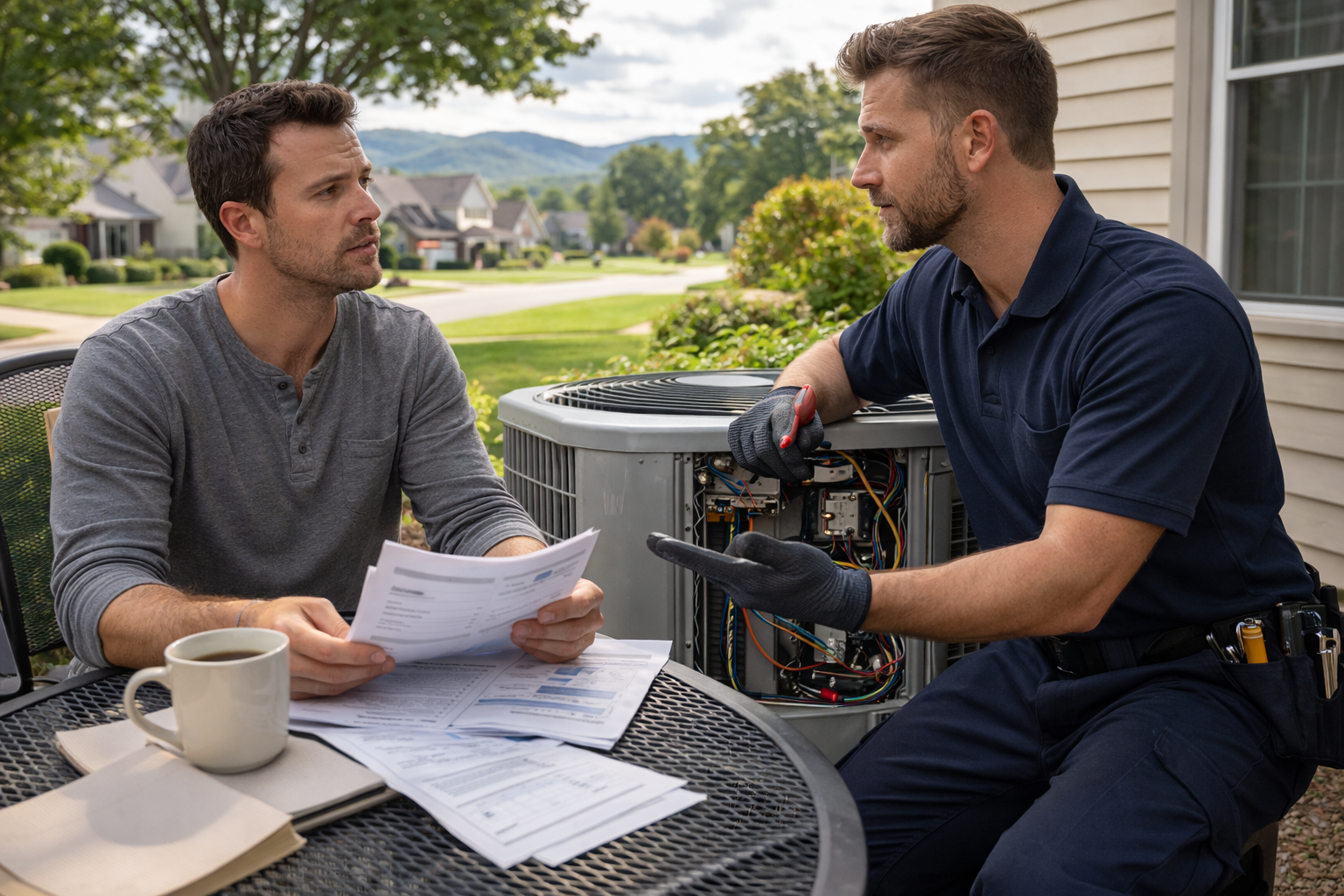
Insist on a detailed written estimate that lists scope, model numbers, efficiency ratings, labor costs, permit responsibility and payment schedule; ask for a single point of contact and turnaround times for questions. Clear communication reduces disputes and speeds project completion, so confirm how change orders and warranty claims will be handled in writing.
Use a contract checklist: include equipment make/model, SEER/COP, Manual J/Manual D confirmation, ductwork changes, start/finish dates (for example, a 10-business-day window), labor warranty length (1–2 years common) and parts coverage (5–10 years). Add permit/liens clauses, a 24-hour contact for issues and a final inspection requirement before final payment to protect yourself.
FAQ
Q: How do I verify an HVAC contractor’s credentials and insurance before hiring them?
A: Ask for the contractor’s state or local license number and verify it on the issuing agency’s website; request proof of general liability and workers’ compensation insurance and ask for the insurer’s contact to confirm active coverage; check for technician certifications (NATE, manufacturer factory training) and membership in professional organizations (ACCA, local trade associations); confirm they pull required permits and handle inspections—legitimate contractors will provide permit numbers and inspection records.
Q: What should I look for when comparing bids and written contracts for a residential HVAC installation?
A: Get at least three written, itemized bids that list equipment brand, model numbers, SEER/HSPF ratings, capacity (tons), and whether the price includes piping, ductwork modifications, electrical work, thermostats, permit fees, and disposal of the old system; require a Manual J load calculation and a description of any duct balancing or sealing; contract should state start and completion dates, payment schedule (avoid large upfront deposits), warranties (labor and equipment), warranty transferability, permit responsibilities, change-order process, and final inspection/commissioning procedures.
Q: How can I evaluate a contractor’s experience, references, and after-installation support?
A: Request references for recent comparable installations and contact those homeowners to ask about timeliness, cleanup, system performance, and service response; read online reviews and check complaint histories with the Better Business Bureau or licensing board; confirm technicians will perform on-site sizing, proper refrigerant charge, and system commissioning at completion; ask about post-install services: emergency service response time, preventative maintenance plans, warranty service process, parts availability, and whether the contractor will register the equipment with the manufacturer on your behalf.